
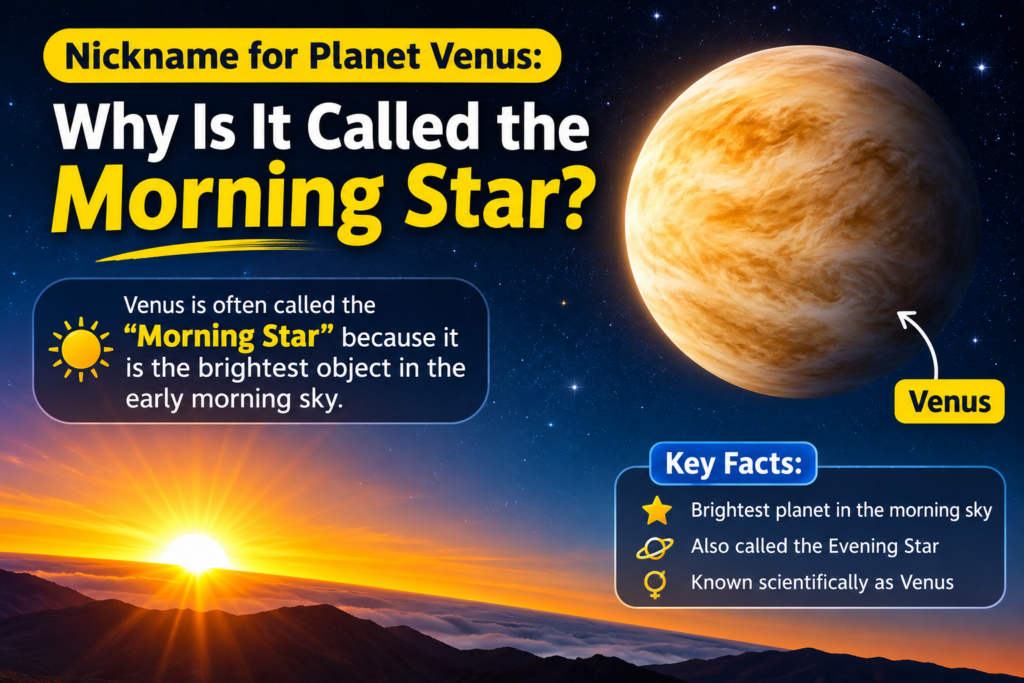
Venus is one of the brightest planets in our solar system. It is easy to notice because it shines near the horizon before sunrise or after sunset. Its bright appearance has caught people’s attention for centuries and inspired many names and stories.
The most common nickname for planet Venus are Morning Star and Evening Star. However, Venus is a planet; it looks like a bright star when viewed from Earth. These names describe when this planet appears in the sky.
How did Venus get its different names?
Before sunrise, ancient people observed a bright object in the eastern sky, and after sunset, they observed another in the western sky. They thought these were two distinct stars because they appeared at different times. The morning appearance was known to the Greeks as Phosphorus, which means “light-bringer,” and the evening appearance as Hesperus. They later discovered they were the same planet.
The Romans also gave these appearances different names. They named the morning object Lucifer and the evening object Vesper. In the end, the planet was named Venus in honor of the Roman goddess of beauty and love.
What makes this planet so bright?
Venus’s bright appearance and dense cloud cover make it stand out. It is easy to see from Earth because these clouds reflect a large portion of the sunlight that reaches the planet.
Venus is sometimes referred to as Earth’s twin because it is similar in size to Earth. Its surface conditions differ greatly. The planet has a dense atmosphere made mostly of carbon dioxide and has extremely high temperatures. Its slow rotation is another interesting feature. On Venus, a single day is longer than a year. It differs greatly from our own planet due to these peculiar circumstances.
When is the right time to observe Venus?
The best time to see Venus in the sky depends on its position around the Sun. Venus moves between the morning and evening sky, so it is not always visible at the same time.
When it appears in the morning, it can be seen in the east before sunrise. When it becomes an evening object, it appears in the west shortly after sunset. Venus can remain visible for a few hours during these periods. It does not stay in the sky throughout the night because it always appears relatively close to the Sun from Earth’s viewpoint.
Why does its position change?
Venus travels around the Sun on an orbit within Earth’s orbit. As both planets move, Venus’s position appears to change in our sky. Venus can occasionally be seen after sunset on one side of the Sun. In other cases, it appears on the opposite side and is visible before sunrise.
Venus shifts between the Morning and Evening Stars because of this movement. This does not mean the planet itself changes course or transforms into something else.
What makes Venus interesting to skywatchers?
Venus is a popular object fr people who enjoy learning about space. Its brightness makes it easy to recognize, and its changing position gives observers something new to look for throughout the year.
It is also an interesting planet to study because of its unusual atmosphere, extreme temperatures, and slow rotation. Even a simple observation can lead to questions about how planets move and why they look different from Earth.
Explore the night sky with experienced guides
Learning how to spot Venus without a telescope is a good starting point for anyone interested in astronomy. Once you know where to look, you can start observing other planets, stars, and celestial objects.
In Sonoma County’s Dry Creek Valley, Night Sky Adventure provides guided stargazing experiences. Explore the night sky with quality telescopes and experienced guides.