Do you remember seeing a bright steady object in the night sky and wondering whether it was a star? Chances are, it was one of the planets in our own solar system. It might look like nothing more than a point of light, but a telescope can reveal its true world, with its own colors, clouds, rings, or satellites orbiting it.
Taking part in a planet viewing telescope tour in California would be one of the best experiences a person could have. This experience lets you see bright planets that are easy to view. You don’t need to know anything about astronomy or telescopes to enjoy it.
Bright, close, and easy to find
Observing faint galaxies and nebulae requires patience, but observing planets gives you instant results. They are among the brightest objects in the night sky, so they are easy to locate even for new astronomers. Planets also show observable details such as rings, cloud belts, and moons, not just points of light.
Saturn: Center of attraction this fall
In NASA’s What’s Up guide for October 2026, Saturn is in opposition, which occurred on October 4. Opposition occurs when Earth lies between the Sun and Saturn, making Saturn appear directly opposite the Sun in our sky. As a result, Saturn rises at sunset and remains visible through most of the night and for weeks afterward.
These are the reasons Saturn is a popular object to observe through a telescope: its rings can be seen with a small telescope and appear unexpectedly sharp. Also, its biggest moon, Titan, is often visible as a tiny dot near it. Saturn has a soft yellowish tint.
Finally, there is a new discovery to communicate about. According to NASA, Hubble recently discovered a ten-sided wave near Saturn’s south pole. You can’t see this with a “basic backyard” telescope, but it adds an interesting twist.
What the other planets look like
You can see planets through a telescope; each has a unique character, and your guide can point out which ones are visible on any given night.
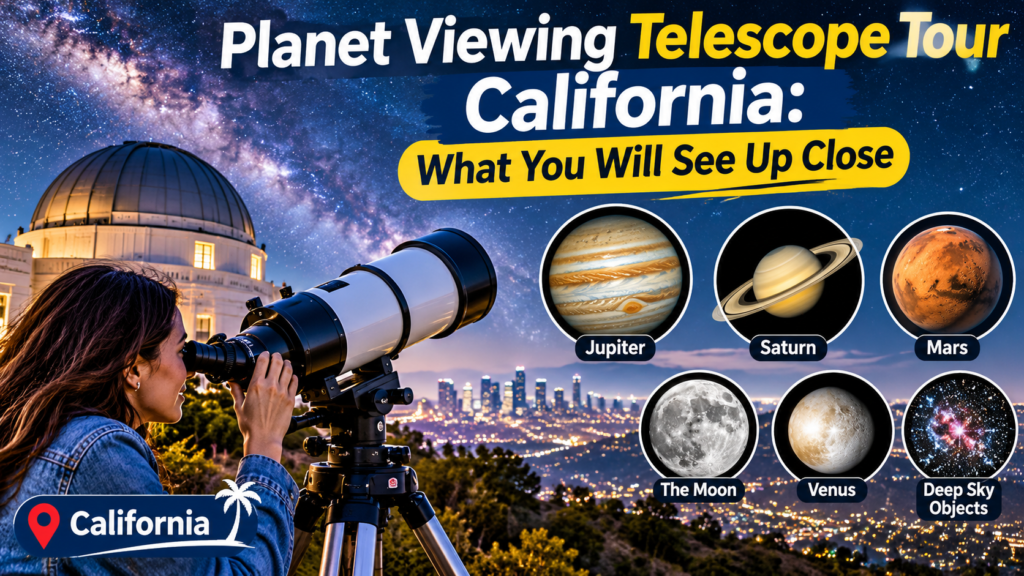
- Jupiter: You will notice dark cloud bands across its disk, along with up to four bright moons lined up. These moons switch positions each night.
- Venus: When visible, it can go through phases similar to the Moon, starting with a thin crescent and progressing to a full disc.
- Mars: It will appear as a small orange disc, with fine details difficult to see because of its color.
As the planets move across the sky through the year, their configuration never repeats itself. As the October guide on NASA’s website indicates, Jupiter is a morning object at the beginning of the month, near a thin crescent Moon before dawn. That is why it is wise to consult with a guide before booking.
Simple ways to make your observation worth it
Here are a few tips to help make the evening easier and enjoyable. You can ask the guide to explain what each planet is made of, since the stories make the views more memorable. Do not forget to give your eyes time to adjust to the dark, as it may affect your experience. Come back in a different season to experience a different set of objects. Explore local astronomy clubs to stay updated.
Ready to see what’s in the dark sky?
Would you like to experience these worlds firsthand with someone who can tell you all about them? Night Sky Adventure offers guided telescope viewing nights right here in Sonoma County’s Dry Creek Valley, where there is no light pollution.
For a unique experience, contact us and book your spot to observe the planets up close! Whether you want to spend time with family or friends, or some alone time, your perspective on our solar system will surely change after our adventure.