
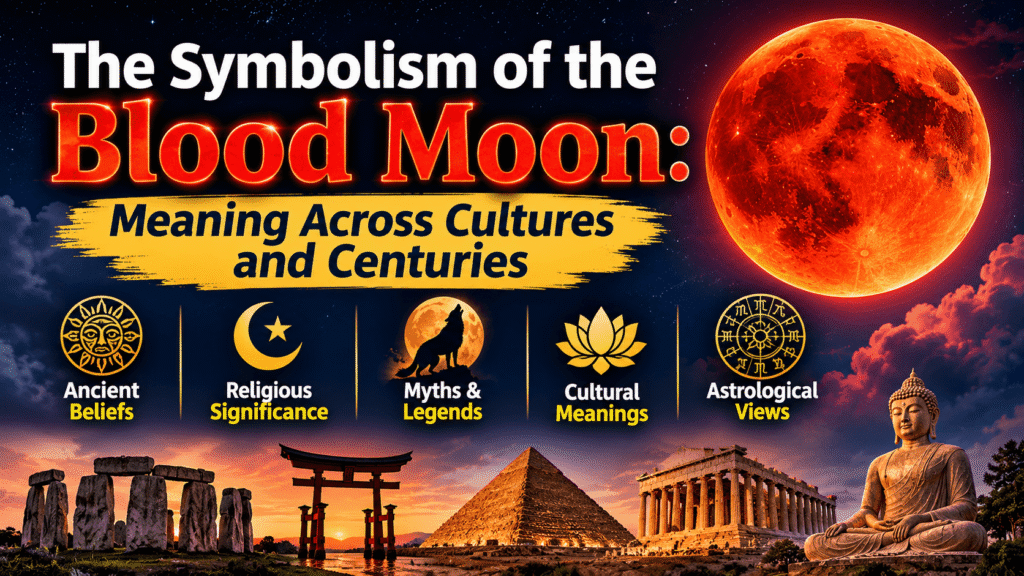
One of the most amazing sights in the night sky is a blood moon. The moon may take on a deep red or copper hue during a total lunar eclipse. In many cultures, this strange sight has sparked stories, beliefs, and curiosity. Over time, the symbolism of the blood moon has evolved; some see it as a warning, while others see it as a sign of change.
Why do cultures name the moon?
Long ago, people named full moons to mark different times of the year. These names helped communities remember seasonal changes and prepare for the months ahead.
Different names of the November full moon in different cultures:
- Beaver Moon: Refers to the time when beavers settle into their homes for winter.
- Frost Moon: The Cree people used this name to describe the first hard frost of the season
- Digging Moon: The Tlingit people use this name for the time when animals search the ground for food.
These names reflect the weather, animals and activities people notice during different parts of the year.
Festivals that follow the full moon
The full Moon has been an essential part of celebrations in various cultures. While some cultures organize festivals around its appearance, others use it to mark certain periods in the year.
Some of these festivals are:
- Mid-Autumn Festival: A Chinese celebration shared across East Asian cultures. It is a family celebration as members enjoy mooncakes and the full Moon.
- Tsukimi: A traditional Japanese celebration of admiring the full Moon during the autumn season.
- Chuseok: A major Korean holiday celebrating the harvest season.
This shows how the full Moon has brought people together through different celebrations.
A red moon in the record of history
Several historical blood moons changed the course of events or advanced human knowledge. Three examples show how differently people responded to the same sight:
- In 413 BC, the Athenian general Nicias delayed his troops’ departure from Sicily after a lunar eclipse because his advisors interpreted the eclipse as a sign. This delay gave the enemy time to prepare, and the whole mission proved disastrous for the Athenians.
- During the 4th century BC, the Greek philosopher Aristotle observed that the shadow cast by Earth on the moon during a lunar eclipse was always circular, leading him to conclude that Earth itself was a sphere.
- Christopher Columbus used a lunar eclipse, which was predicted to happen in 1504, to pressure local leaders to provide food supplies for his men.
Each story tells a different reaction. One explorer used the sign, one scholar studied it, and one leader feared it. Together, they show how the same incident can serve as a tool, a lesson, or a warning.
Why does the moon sometimes look red without an eclipse?
Have you noticed a huge orange-colored moon over the horizon? While it looks like a blood moon, that does not necessarily mean there will be a lunar eclipse that night.
During a lunar eclipse, the moon passes through the Earth’s shadow while Earth is located between the Sun and the moon. At this time, sunlight passes through Earth’s atmosphere, giving the moon a copper or deep red color. As the moon is situated low in the sky, light from the moon has to travel a longer distance. As such, most of the blue light in the moon’s rays gets scattered while the orange and red light gets through.
How long does the red glow last?
Many people wonder, “when does the blood moon ends”. During a total lunar eclipse, the moon does not stay red for the entire event.
Here is how long the different stages can last:
- Red phase: The moon can remain inside the darkest part of the earth’s shadow for yuo to about 1 hour and 4 minutes.
- Complete eclipse: The entire process, from beginning to end, usually takes three to four hours.
- Orange moon near the horizon: Its color often changes as it rises higher in the sky, usually within an hour or two.
The exact timing depends on the eclipse and the moon’s position in the sky.
Experience the night sky in person
Reading about the moon is interesting, but observing the night sky through a telescope can make the experience even more special. Night Sky Adventure offers a guided stargazing experience at a dark-sky location in Sonoma County’s Dry Creek Valley, away from any light pollution and disturbance.