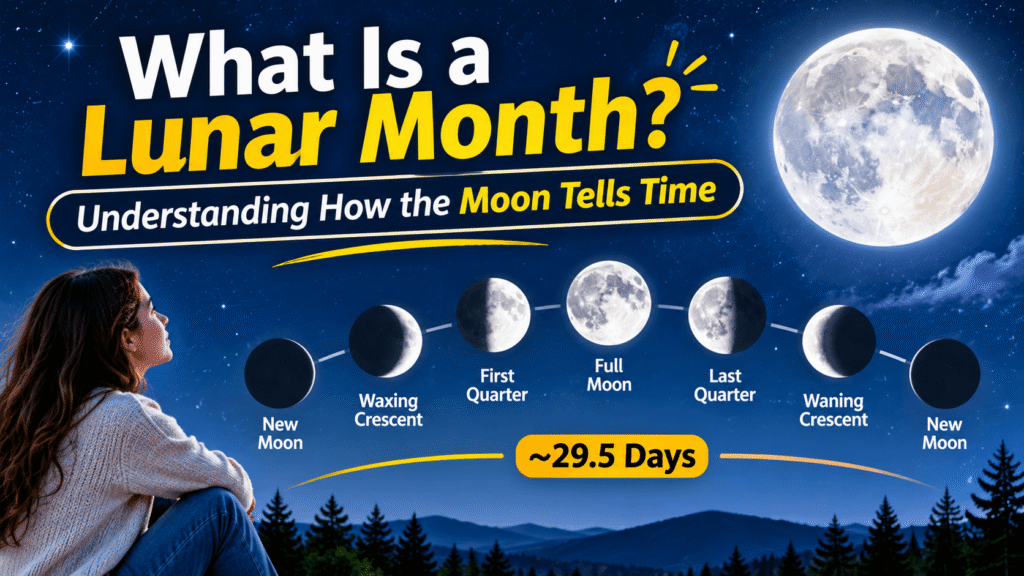
Before the invention of clocks and calendars, people used the Moon to determine the time. A small, curved moon showed the start of a new cycle. A big, bright full moon showed that the cycle was halfway done. And when the Moon was difficult to see, that meant the cycle was almost over.
What is a lunar month, then? It is the time the Moon takes to transform from one new Moon to the next. This takes roughly one month, or 29.5 days. Because of this, people have always used the Moon to help them keep track of time.
A month measured in moonlight
Astronomers call this cycle the synodic month, and it lasts about 29.53 days. The word “synodic” comes from a Greek word meaning “meeting”, because each cycle begins when the moon meets the sun in our sky. That meeting is the reason we call the start of the cycle a new moon.
The length of the cycle varies slightly from month to month. The moon does not travel in a perfect circle, so it speeds up in some parts of its path and slows down in others. Because of this, one cycle can be as much as half a day longer or shorter than the one before it. So, 29.9 days is just an average number.
Two ways to measure the Moon’s trip
Imagine that the Moon is making a large circle around the Earth. The Moon completes a full orbit in roughly 27.3 days. But there’s a small problem: while the Moon is running, the Earth is orbiting the Sun at the same time. It takes the Moon an additional two days to catch up to the Sun and show the same phase again.
Why does a Moon-based year fall short?
A year based on Earth’s orbit around the Sun has roughly 365 days, but twelve lunar cycles make up 354 days. This indicates an annual difference of 11 days.
Due to this, lunar and solar calendar function differently.
- The Sun is followed by a solar calendar, which keeps the seasons around the same dates each year, but its months do not follow the phases of the Moon
- The Moon is followed by a lunar calendar. Its months match the Moon phases, but the seasons change over time.
This gap is the center of the debate over solar calendar vs. lunar. An excellent example of a lunar calendar is the Islamic calendar. When people notice the first thin crescent moon, the months officially begin. For this reason, Ramadan begins approximately 11 days earlier every year.
See the Moon’s cycle for yourself
If you would like to learn the night sky with an expert beside you, Night Sky Adventure offers guided evenings at a dark-sky observing site in Sonoma County’s Dry Creek Valley, far from city lights. The guides explain what you are seeing in clear, simple terms and help you choose the night that suits you best. Contact us today to reserve your spot and watch the moon with us.