
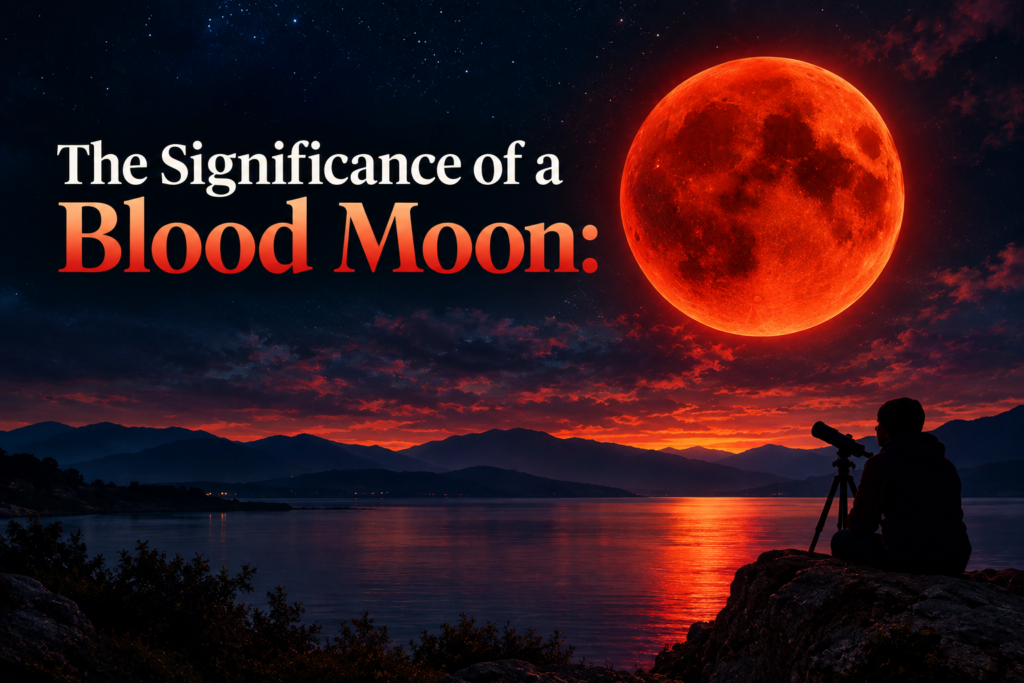
You’re not alone if you’ve ever caught a glimpse of the full moon turning a deep copper-red and experienced a strange feeling of curiosity. This reaction is very common throughout human history, as people look up at the sky and become more curious.
The significance of a blood moon is more than a pretty picture. Positioned at the intersection of astronomy, mythology and human curiosity, this one-of-a-kind alignment of the Sun, Earth, and Moon has shaped religious writings, calendars and folklore. It will matter a lot more next time you see one – if, of course, you have some idea what was really going on up there and why it’s attracted so much interest.
The Moon’s Cycle Sets the Stage
Zooming out and examining the moon’s phases in general can help you truly understand a blood moon. Every 29.5 days or so, the moon goes through a repeating cycle that includes the new moon, crescent, first quarter, full moon, and back again. The moon’s position in relation to the sun and Earth determines each phase.
Only when Earth is directly between the Sun and the Moon during the full moon phase can a blood moon occur. Nothing important occurs during most months because the moon’s slightly tilted orbit causes it to pass just above or below Earth’s shadow. Occasionally, the alignment is accurate enough for Earth’s shadow to completely cover the lunar surface, which is when the magic takes place.
Here are some details regarding this alignment:
- It never happens during a partial lunar eclipse; it can only happen during a total lunar eclipse.
- The moon remains visible, but it glows red rather than white.
- Somewhere on Earth, these alignments take place a few times a year, but only a portion of them are captured by a single location.
- It’s important to check regional visibility in advance because you won’t always be able to see the next total lunar eclipse from your exact location.
Why Ancient Cultures Took It So Seriously
Long before anyone understood orbital mechanics, a moon suddenly turning blood red was unsettling, even terrifying. Depending on where you lived in the world, interpretations varied widely:
- Some cultures saw it as a sign of conflict or upheaval on the horizon.
- Others saw it as a moment of cosmic renewal or spiritual purification.
- The occasion was cited as a significant turning point in several ancient calendars and religious texts.
- During the eclipse, storytellers would frequently create whole myths about a creature “biting” or “swallowing” the moon.
It’s amazing how many civilizations came to the same conclusion that this moment mattered and required attention, even in the absence of cross-continental communication. That instinct has simply changed from fear to curiosity, but it hasn’t truly vanished.
What Gives the Moon Its Red Color?
Sunlight is the main scientific cause of this red color. As Earth blocks direct sunlight from reaching the Moon, some light still bends around Earth’s edge through the atmosphere. Red and orange rays bend through and land on the lunar surface, creating that distinctive reddish glow, while blue light scatters away.
You are essentially witnessing every sunrise and sunset on Earth reflected onto the moon at once, which is why sunrises and sunsets appear the way they do. The color can change from a gentle orange to a deep, nearly blood-like crimson due to dust, smoke, and volcanic particles in the atmosphere.
Understanding the Eclipse Timeline
After missing an eclipse, people frequently look for “what time was the blood moon” to find out precisely when it peaked. Any total lunar eclipse is determined by three distinct phases:
- Penumbral phase – The moon dims slightly as it enters the outer edge of Earth’s shadow, barely visible to the naked eye.
- Partial phase – A visible section appears to be taken out of the moon as it moves deeper into shadow
- Totality – The moon turns fully red and stays that way for anywhere from a few minutes to over an hour.
The same eclipse may peak at a completely different local time for someone across the nation because exact clock times vary by time zone and geographic location. Checking a reliable astronomy source ahead of time is the easiest way to find the date and time of the next eclipse.
What Does It Mean to Witness One Today?
To understand what’s going on during a blood moon, you don’t have to believe in omens. For a lot of people, it’s become something closer to a mindfulness moment, a reason to go outside, put the phone down, and, for once, look up at the night sky and relax.
Some common reasons people find the experience meaningful today:
- A rare, slow moment spent outdoors under a dark sky.
- A visual reminder of just how precisely the solar system moves
- A shared experience, eclipses tend to bring families, neighbours and friends outside at the same time.
- A great entry point for anyone curious about astronomy but not sure where to start
Getting the Most Out of the Experience
Although a blood moon is visible to the naked eye, a few minor decisions can significantly alter how memorable it feels:
- Choose a location away from the city’s glow and streetlights.
- Arrive early; the partial phases are also worth seeing, but the totality is the main attraction.
- Since watching eclipses frequently requires standing motionless for a while, bring warm clothing.
- For a truly unique perspective of lunar detail and color, use binoculars or a telescope.
See It For Yourself With Us
It’s one thing to read about a blood moon; it’s quite another to be under a truly dark sky during one. With top-notch telescopes and knowledgeable astronomer guides on hand to guide you through every stage of the event, Night Sky Adventure offers guided stargazing tours from a dedicated dark-sky observing site in Sonoma County’s Dry Creek Valley, well away from city light pollution. Experience the next blood moon as it was intended to be seen by scheduling a tour with us.