
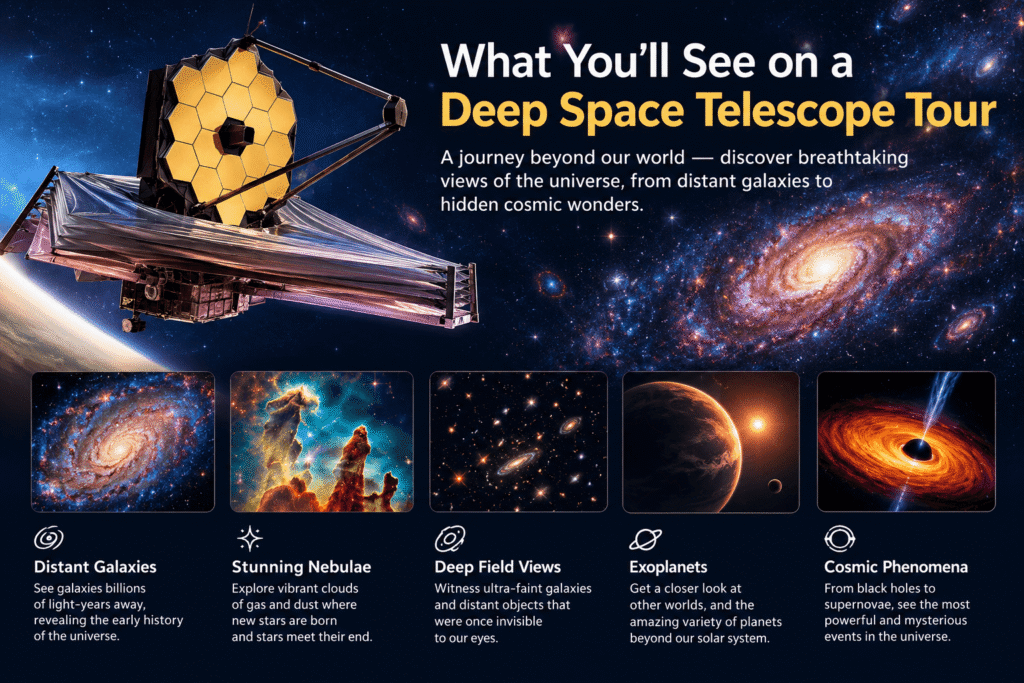
Imagine yourself in a dark field on a cold night, looking through an eyepiece. At first, all you see is a blurry spot of light. As your eyes get used to the darkness, the spot gradually becomes a glittering cluster of stars. Many people believe this is the moment they feel that they are looking at the real universe rather than some image in a book.
This is precisely what a deep space telescope tour is all about. Instead of spending the entire night viewing the moon and neighboring planets, you spend the night exploring objects far beyond our solar system, like luminous clouds of gas, dense clusters of stars, and many galaxies. A guide selects the best objects to observe for the night, aligns the telescope, and tells you what you are viewing.
Why Dark Skies Make All the Difference
A glowing cloud that looks beautiful in photographs may not be visible from a backyard in town because streetlights pollute the sky. Therefore, such nights are always held away from streetlights.
This is what a true dark-sky location offers you:
- Dark skies will help you see the Milky Way as a band of light
- Faint Objects are never visible from a suburb
- A more tranquil environment, where it is easy to concentrate on your view
- Better contrast, making all objects in the eyepiece look sharp
Your eyes also require some time to adjust. Most people can see a clear difference after 15 minutes in the dark, and dim red light helps you to see your footsteps because white light, even from a phone, can reset that process.
Galaxies and Glowing Clouds Far Beyond Our Neighborhood
Most visitors would first visit the Andromeda galaxy, our nearest large galactic neighbor. It is located about 2.5 million light-years away, meaning the light you see left the galaxy long before humans came into existence. On a clear night, you can see it with the naked eye, and a telescope reveals its bright core.
Other popular sights include planetary nebulae, the glowing remains of a star after it dies. The Ring Nebula resembles a smoke ring, and the Dumbbell Nebula is shaped similarly to an apple core. These celestial bodies are small and fragile, making them a rewarding sight to observe.
Where New Stars Are Born
If you get the chance to go on a star birth nursery telescope tour, the Orion Nebula would be the main attraction of the evening because it is a large cloud of gas where new stars are forming right now.
What makes it so popular with first-time visitors:
- Bright enough to be seen well through even a small telescope
- It has a cluster of very young stars known as the Trapezium in its center
- It has a pale grey-green color that photographs tend to emphasize too much
- It is an actual, ongoing location of star formation and not a picture of a past event
Winter evenings are the classic time to see this. Orion also begins climbing into the late evening sky as autumn goes on, so the view is already worth waiting for.
Crowds of Stars That Sparkle Like Jewelry
Star clusters are some of the easiest objects to love. A telescope turns a faint patch into hundreds or even thousands of individual stars, and each one shows its own color and brightness. A Double Cluster in Perseus is visible to the naked eye in dark locations and is always rewarding in binoculars or a small telescope.
There are two main types, and a star cluster telescope tour includes both:
- Open clusters, such as the Double Cluster in Perseus and the Owl Cluster near Cassiopeia.
- Globular clusters, such as Messier 15 in Pegasus, which are tightly packed balls holding hundreds of thousands of stars, and look like a pile of tiny diamonds in a telescope.
Clusters also have a practical benefit. They stay bright and clear even when the moon is up, so they are a nice option on nights when light objects fade out.
How the Moon and Seasons Shape Your Night
Timing matters far more than most people think. The moon is another form of light pollution; therefore, the best night for faint galaxy and nebula hunting is when the moon is new. When the moon is brighter, guides usually shift to objects that can handle the light, such as globular clusters.
Seasonal changes also influence your bucket list. Autumn evenings are characterized by high visibility of Andromeda and the Double Cluster constellation; later in the year, Orion comes on stage.
Simple Ways to Get More From the Evening
A little preparation helps the night feel comfortable and easy. Things you can prepare are:
- Dress warmer than you think you need to, since standing still gets cold quickly
- Skip bright phone screens, or turn the brightness all the way down
- Ask plenty of questions, because guides love sharing the story behind each object
- Take your time at the eyepiece, since the details keep appearing the longer you look
Plan Your Evening With Experts
If you want to see these sights without worrying about finding targets or setting up gear, Night Sky Adventure offers guided evenings, far from city lights. Premium telescopes and expert guides do the technical work, so you can focus on looking up and asking questions.