
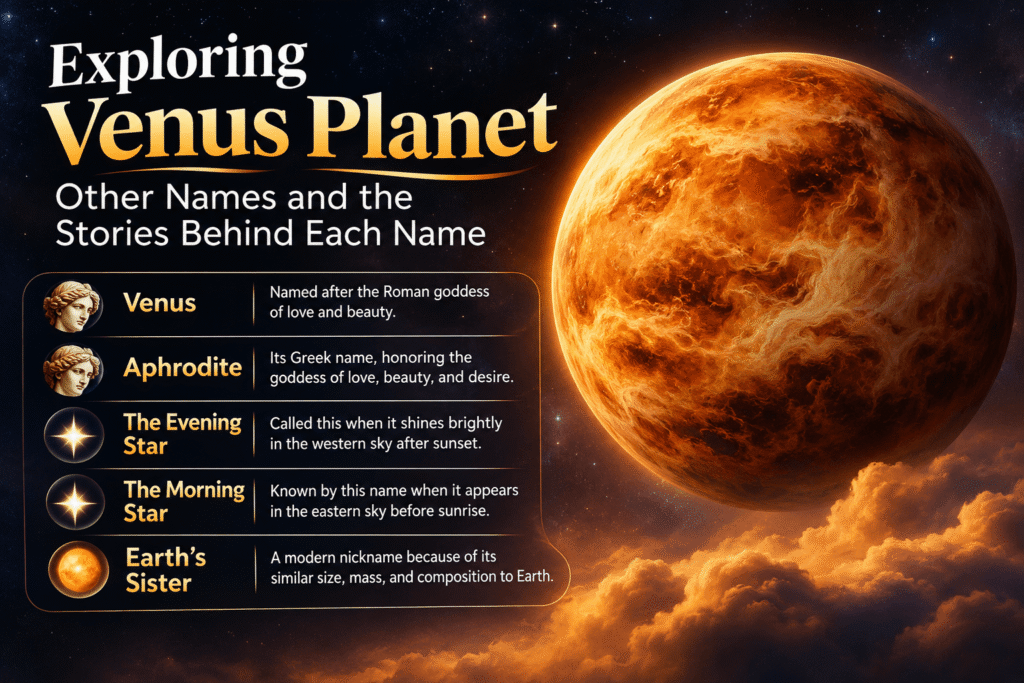
Venus has more names than any other planet. In ancient times, people considered it the brightest thing in the sky after the Sun and the Moon. At dawn and dusk, it glowed near the horizon with a bright light that was nearly impossible to miss.
There are numerous Venus planet other names because various cultures observed it closely and gave it a role in their stories, myths, calendars and religions. Knowing about these names tells us how humans responded to the bright light present in the sky.
Why was Venus known by two different names?
A bright object in the western sky after sunset and another in the eastern sky before sunrise were frequently observed by ancient observers. Many people thought they were two different stars because they appeared at different times.
The evening appearance was named Hesperus by the Greeks, while the morning appearance was named Phosphorus, which means “light-bringer.” They later discovered they were the same planet. Similar customs were observed by the Romans, who used Lucifer for the morning appearance and Vesper for the evening.
Venus received its modern name from the Roman goddess of love and beauty. The most common nickname for planet Venus are Morning Star and Evening Star. These names describe when it appears in the sky, even though Venus is a planet, not a star.
How different cultures named Venus
Venus’s brightness and consistent movement attracted people from all over the world. Its names were derived from the languages, beliefs, and observations of various civilizations.
For instance, the Mesopotamians linked Venus to Ishtar, a goddess associated with both love and war. It was known as Taibai, meaning “Great White,” and Jinxing, meaning “Metal Star.” Shukra, which means brightness and learning, is the name used in Indian astronomy. Venus is referred to as Al-Zuhara in Arabic-speaking cultures, which translates to “the bright one.”
The Maya also studied Venus carefully. They tracked its cycle of approx. 584 days and documented their findings in ancient codices. These documents show how closely people used to track the planet’s motion.
Why can we only see Venus during certain hours?
Venus does not remain visible throughout the night because its orbit is closer to the Sun than Earth’s. From our viewpoint, it always stays relatively close to the Sun, reaching a maximum distance of 47 degrees.
This is why Venus in the sky at night is usually visible only during twilight. It appears in the west shortly after sunset or in the east before sunrise. It does not rise high in the sky around midnight. Its position changes over several months.
What can you expect to see from Venus this November?
Venus is visible in the morning sky this November. On October 24, it passed between Earth and the Sun, and since then, it has progressively gotten easier to see before dawn.
It rises less than an hour before the Sun at the start of the month. It rises almost three and a half hours earlier by the end of November. Its brightness also increases, reaching about magnitude -4.9 on November 29.
Venus is therefore a great target for early-morning skywatching. Even without a telescope, it is easy to identify because of its bright appearance.
How can you find Venus before sunrise?
Venus is usually visible without a telescope or other specialized gear. An hour before sunrise, look east or southeast. It typically has a constant glow and appears as a very bright point of light.
Pick an open spot where you can see the eastern horizon clearly for the best view. Choose a location free of obstructions, as trees and tall buildings may block your view. Binoculars can also be used to view the nearby stars.
Another object to look for near Venus in November is Spica. On the morning of November 19, the two will appear especially close, providing early risers with an interesting sight.
Explore the night sky with experts
Venus is just one of many interesting celestial bodies worth seeing. At a dark-sky location in Sonoma County’s Dry Creek Valley, Night Sky Adventure provides guided viewing experiences for those interested in learning more about planets, stars, and other celestial objects.