
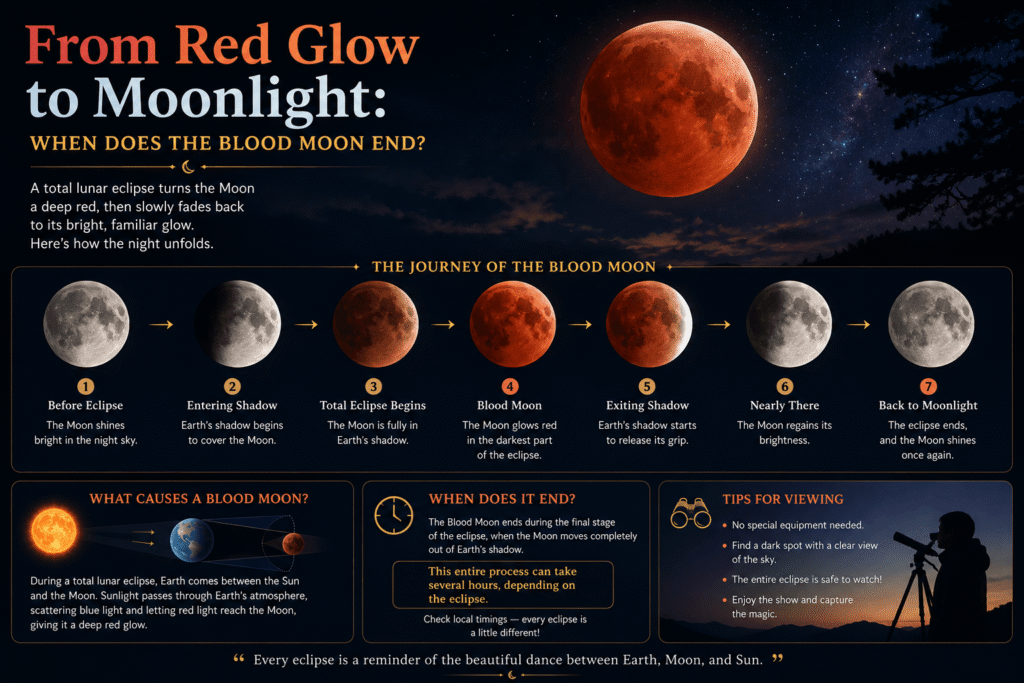
The blood moon is considered to be one of the most exciting astronomical phenomena to observe. During a total eclipse of the Moon, the lunar satellite gradually fades from its well-known white color to various shades of orange and dark red before returning to its natural color. Unlike a solar eclipse, this is completely safe to watch with the naked eye.
If you have been asking yourself when does the blood moon end, the answer will vary depending on the particular phases of the eclipse. While the most exciting red phase typically takes place during 60 to 100 minutes, the total lunar eclipse itself can last up to 5 to 6 hours from the time the Moon enters Earth’s shadow.
What Causes a Blood Moon to Glow Red?
A blood moon is a phenomenon that occurs only during a total lunar eclipse, when the Earth comes between the Sun and the Moon. Even though the Sunlight is blocked by the Earth, some sunlight manages to pass through the Earth’s atmosphere and reach the Moon.
The light is filtered of its blue components as it passes through Earth’s atmosphere, but red and orange components manage to bend and reach the surface of the Moon.
There are several astronomical factors that explain this amazing phenomenon:
- The average distance from the Earth to the Moon is 384,400 kilometers.
- The diameter of the Moon is 3,474 kilometers.
- The Moon takes 27.3 days to make a revolution around the Earth.
- A total lunar eclipse occurs only during the Full Moon.
- The size of the Earth’s umbra, where the Moon appears to turn red, is 9,200 kilometers across at the Moon’s distance.
This exact combination results in one of the most stunning phenomena in the sky.
| Blood Moon Facts | Details |
| Eclipse Type | Total lunar eclipse |
| Average Earth–Moon Distance | 384,400 km |
| Moon’s Diameter | 3,474 km |
| Average Totality Duration | 60 – 100 minutes |
| Complete Eclipse Duration | 5 – 6 hours |
| Safe to View? | Yes, no eye protection required |
| Required Moon Phase | Full Moon |
The Journey From First Shadow to Full Moonlight
There is an order of events that occurs during a blood moon, although most people mistakenly believe that the event ends when the moon reaches its deepest red.
However, the moon goes through some stages:
- First, the moon enters Earth’s outer shadow, called penumbra.
- Then, the moon is covered by Earth’s darkest shadow, which is the umbra.
- Then comes totality, during which the moon turns the famous deep red.
- Then the moon slowly moves out of the umbra.
- Afterwards, the brightness of its surface starts to reappear.
- Finally, the eclipse ends when the moon exits Earth’s penumbra.
Knowing every stage gives you an idea of how the Earth, Moon, and Sun interact in space.
When Can You Watch Another Blood Moon?
Planning your next eclipse experience requires understanding what will happen. The next blood moon in 2026 is not a total lunar eclipse, but an extraordinarily deep partial lunar eclipse which will occur on 27–28 August 2026. In this event, 96% of the Moon will pass through Earth’s darkest shadow, giving it the distinctive red-orange color throughout most of the eclipse.
The next actual blood moon requires a little more patience from astronomy enthusiasts. The next total lunar eclipse is expected to take place on 31 December 2028 – 1 January 2029, when the year will end with a deep-red Moon. It is expected that the eclipse will be visible from Europe, Asia, Australia, Africa, and some parts of the Americas. This eclipse would be one of the most eagerly awaited events of the decade.
No matter whether you decide to witness the partial lunar eclipse in 2026 or wait until the one in 2028–2029, checking the weather and eclipse timing beforehand is important for a full experience.
Every Eclipse is a Chance to Learn Something New
It is not just a visually pleasing phenomenon. It is a reminder of the remarkable perfection of our solar system and the ongoing movements of the Earth, the moon, and the Sun. To get an idea of the interaction between these celestial bodies and why each phenomenon becomes memorable, you need to watch the entire eclipse, not just the phase when the moon turns red.
If you want to witness some truly impressive phenomena and have your events led by professional guides, you should give Night Sky Adventure a try. You will never look at the stars in the same way again.