
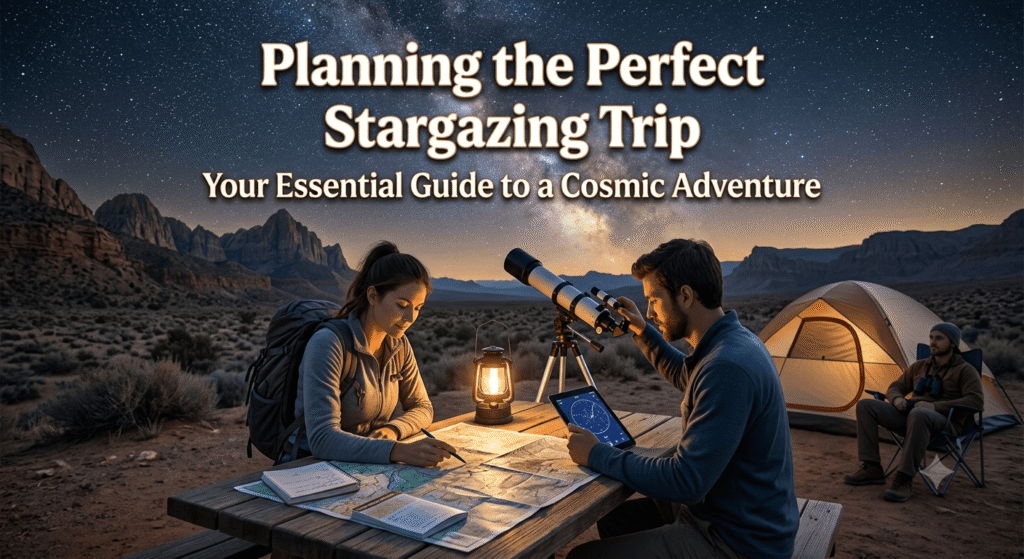
Standing beneath a truly dark sky creates a certain kind of silence. Thousands of stars stretched out overhead in a way that most people hardly ever get to see these days, no streetlights, no glowing phone screens. It’s the kind of moment that you usually remember.
If that sounds like something you’d love to do, then creating your own star gazing trips is not the hardest thing you will ever have to do, but there are a few things you need to plan beforehand so it can be a memorable experience rather than a frustrating one. A little planning goes a long way when it comes to casual stargazing, from picking the right location to the right time for your visit.
Why Location Makes or Breaks the Night
Your gears are not the most important factor in determining how much you will actually see; rather, it is your position. Light pollution from cities and suburbs makes it difficult to see the brightest stars, which is why so many devoted observers travel far outside of town before setting up.
Here are some things to consider when choosing a location:
- The skies are noticeably darker in rural areas far from large cities.
- Because you’re above more of the atmospheric haze, elevation also helps.
- The open sky is important because trees, hills, and buildings can obstruct your view of the horizon.
- Before you commit to driving anywhere, you can use a light pollution app or dark sky map to find the closest good option.
Why the Moon’s Phase Matters More Than You’d Think
It may surprise you to know that a bright full moon can actually work against you. Just as city lights wash out fainter stars, galaxies, and nebulae, its glow does the same. Timing is just as important as location if you want to have a stargazing experience with the Milky Way clearly visible.
- The darkest skies for deep-sky viewing are available on new moon nights.
- Even when a crescent moon sets early in the evening, a good view is still possible.
- If you use a telescope to study lunar details, full moon nights are still worthwhile.
- You can schedule a trip around planetary conjunctions, meteor showers, and other events by consulting a monthly sky calendar in advance.
What You Can Actually See Up There
When your eyes adjust and the sky is sufficiently dark, one of the most frequent surprises for newcomers is how much is visible. Any clear night could show you:
- Venus, Jupiter, Saturn, and Mars are examples of planets that are frequently bright enough to see without any equipment.
- Binoculars reveal unexpected color and structure in star clusters and double stars.
- The Milky Way’s fuzzy band, which stretches across the sky far from city lights
- Nebulae and distant galaxies that appear as faint smudges to the unaided eye but come to life when viewed through a telescope
Giving your eyes 15 to 20 minutes to adapt to the darkness significantly improves the amount of detail you can see, even without a telescope.
DIY vs. Guided Stargazing
Getting a blanket, driving somewhere in the dark, and looking up by yourself is perfectly acceptable. But for all of that, you need to have proper knowledge of exactly what you’re looking at, how to operate a telescope correctly, and which nights are truly worth the drive.
This is where guided stargazing tours in California are popular among both tourists and residents, and begin to make much more sense, particularly for newcomers:
- In real time, a knowledgeable guide can identify the precise planet, star, or galaxy you are viewing.
- Compared to most personal equipment, professional-grade telescopes reveal far more detail.
- Finding a suitable location on your own is no longer necessary with the help of a dedicated dark-sky website.
- A passive evening of gazing up can be transformed into something truly educational by the guides’ ability to respond to questions immediately.
Making the Trip Comfortable
Even in the warmer months, sitting still outside at night quickly gets chilly after the sun sets. A little planning keeps your attention on the sky rather than your discomfort.
- Even if it felt warm during the day, wear layers of clothing.
- For longer sessions, bring a blanket, recliner, or camping chair.
- Because white light impairs nite vision, carry a red-light flashlight rather than a standard one.
- On longer outings, snacks and a thermos of something warm are very helpful.
Making It a Group Occasion
It’s easy for stargazing to become a communal activity. Families introducing children to astronomy for the first time, groups of friends seeking something different from a typical nite out, and couples seeking an unforgettable date nite all tend to find it works best as a planned outing rather than an impromptu one.
A trip like this tends to shine on the following occasions:
- Proposals or anniversaries under a truly spectacular sky
- Family outings where children can interact directly with a real telescope
- Going on team outings or celebrations in search of something special
- Anyone looking for a peaceful evening away from screens can go on solo excursions.
Book Your Stargazing Trip With Experts
If you’d prefer to avoid the guesswork and get right to the good stuff, Night Sky Adventure offers guided tours from a dedicated dark-sky observation site in Sonoma County’s Dry Creek Valley, away from city light pollution and surrounded by rolling hills and vineyards. It’s one of the simplest ways to make an outdoor evening truly remarkable, with top-notch telescopes and knowledgeable guides to elevate your experience of everything you’re seeing. Make your reservation with us to witness the true night sky when there are no obstacles in the way.