
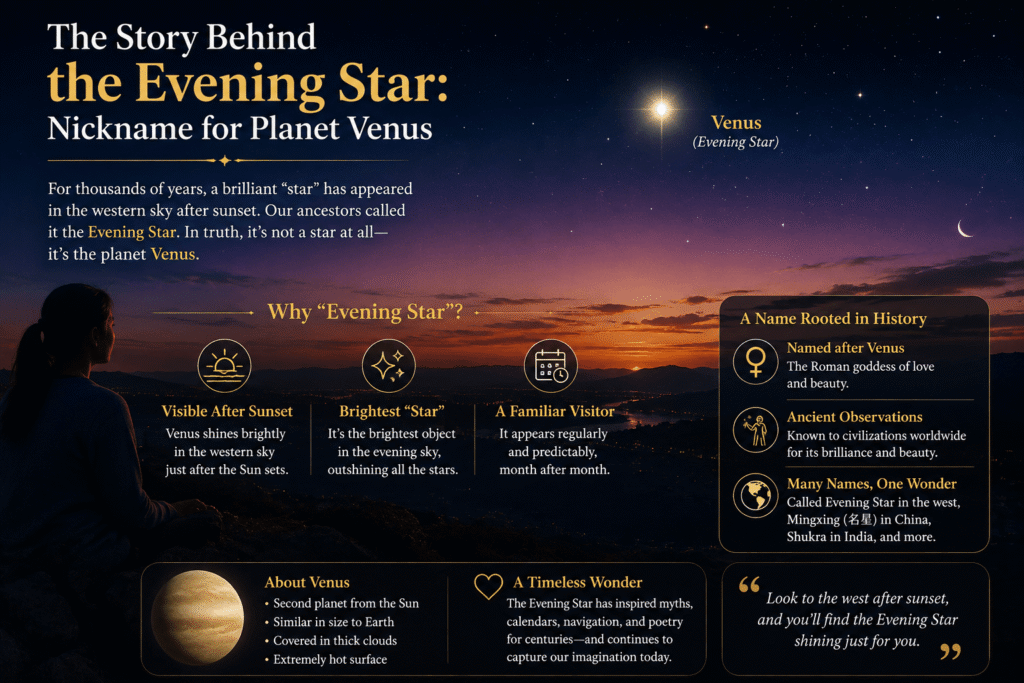
Venus has always been one of the most easily identifiable planets in the sky for thousands of years. It has been an inspiration for myths and tales, helped travelers in various ways, and was an object of research for astronomers. Today, it remains a favorite celestial body among astronomers, and beginners love observing it because it is usually visible even without a telescope.
The most commonly known nickname for planet Venus is the Morning Star and the Evening Star. The names are associated with the appearance of the planet before sunrise or after sunset. Venus is the 2nd planet from the Sun, its diameter is 12,104 km, and it makes one orbit in 225 days.
Why Does Venus Shine So Brightly?
While stars emit their light, Venus does not have its own source of light. The planet emits light by reflecting sunlight through its dense clouds, which cover almost the whole surface. It is estimated that the density of these clouds results in about 70% reflection of the rays of the sun, and hence, it is the brightest of all planets in the sky.
The brightness of the planet is also determined by its position, since it is closest to Earth, at about 41 million kilometers. Due to its proximity to our planet and its high reflectivity, it is among the first objects visible after sunset and before sunrise.
All these features make Venus noticeable throughout the year.
Fascinating Numbers That Make Venus Unique
Venus is often called Earth’s twin planet due to their similar size. Venus and Earth share similarities, but they also have unique features that set them apart. Its atmosphere, climate, and rotation make it one of the most extraordinary planets in the solar system. These features explain why scientists are interested in Venus.
Some interesting information related to this planet is:
- Venus has a diameter of 12,104 km (approx.).
- The average surface temperature is around 465°C.
- A single day on Venus is about 243 Earth days.
- The duration of a Year on Venus is 225 Earth days.
- It has 0 moons and 0 planetary rings.
- The atmosphere is made up of 96% carbon dioxide.
This information gives us some clues as to why the study of Venus persists even now.
How Did Different Cultures Describe Venus?
Individuals from many different civilizations had observed the planet long before the development of astronomy. This is why there have been Venus planet other names, which usually had more to do with cultural beliefs and myths than with scientific knowledge.
In Roman civilization, the planet Venus was named after their goddess of love and beauty, whereas in Greek civilization, it was named after their goddess Aphrodite. And other civilizations saw it as the Morning Star and Evening Star until it was discovered that they were observing the same celestial body.
These names are evidence of the close connection between astronomy and myths. Even today, many of these historical names are popular.
What is the Best Time to Spot Venus?
It is easy to spot Venus due to its high luminosity. However, this planet cannot be seen throughout the whole night. Depending on its orbital placement, Venus can either rise just before sunrise or after sunset, which makes it the Morning Star and the Evening Star.
In order to increase your chances of seeing Venus, you need to do the following:
- Spot Venus on the eastern horizon before sunrise, when it rises as the Morning Star.
- Locate Venus on the western horizon after sunset, when it rises as the Evening Star.
- Pick a place with low light pollution.
- Check your stargazing calendar in order to see when Venus will reach its maximum luminosity.
- Watch Venus during clear weather.
Being aware of the timing and location makes it significantly easier to find Venus and appreciate one of the brightest planets of our solar system.
What is the Best Way to Observe Venus?
You don’t need expensive equipment to observe Venus. In many cases, the planet is bright enough to be visible with the naked eye.
Tip to improve your view:
- Observe the planet a few minutes after sunset or sunrise.
- Select a place with low light pollution.
- Ensure you consult a planetary observation calendar before visiting.
- Consider using binoculars for better viewing.
- Allow your eyes to get used to the darkness for about 20 minutes.
- Avoid looking at Venus when it is near the Sun.
Planning ahead makes it much easier to identify and observe Venus.
| Venus at a Glance | Details |
| Position from the Sun | 2nd planet |
| Average Diameter | 12,104 km |
| Closest Distance to Earth | About 41 million km |
| Length of a Day | About 243 Earth days |
| Length of a Year | About 225 Earth days |
| Average Surface Temperature | Around 465°C |
| Natural Moons | 0 |
| Planetary Rings | 0 |
Why is Venus Still One of the Most Popular Planets to Watch?
Venus has continued to hold people’s interest due to a combination of beauty and mystery. The planet looks peaceful from Earth, but in reality, it is one of the hottest in our entire solar system. In addition, observing Venus in the sky at night allows beginners to distinguish between the movements of planets and stars.
If you are interested in stargazing under the guidance of expert astronomers, I recommend the Night Sky Adventure program, which offers an unforgettable experience for both children and adults. Where every session brings a new opportunity to learn and appreciate the universe.