
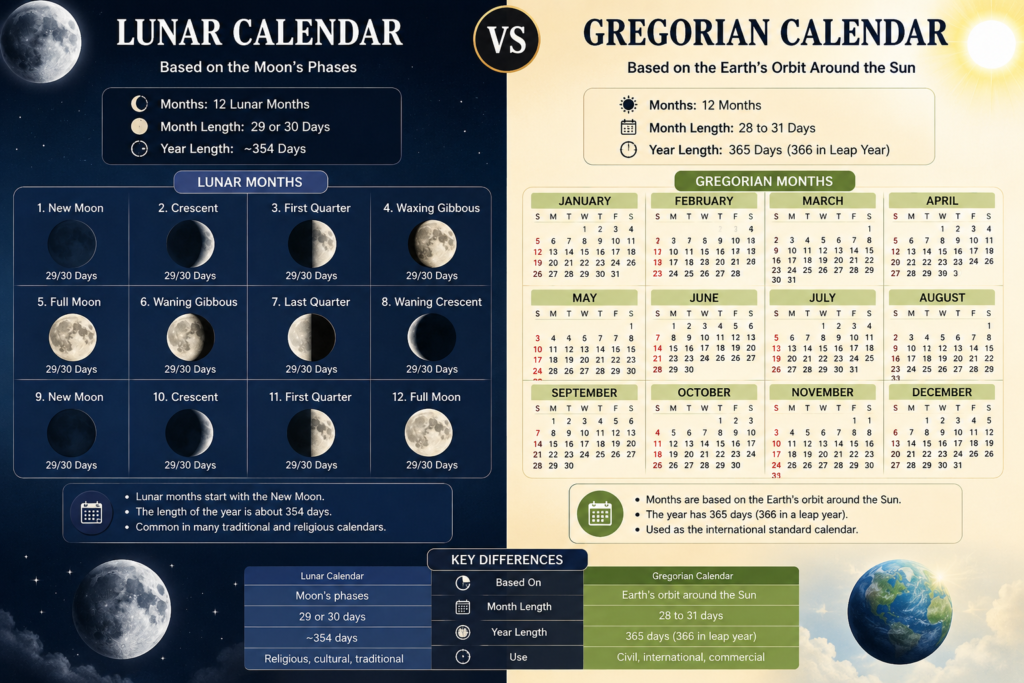
Understanding the solar calendar provides essential information about how most of the world measures time. The solar calendar is based on the Earth’s orbit around the Sun, a cycle that takes around 365.24 days to complete. It works well for agriculture, education, and day-to-day activities because the seasons are unchanged from year to year. While many cultures still use the lunar calendar, the solar calendar is the official calendar worldwide for all civil and commercial purposes.
How Does the Gregorian Calendar Keep Track of Time So Well?
The Gregorian calendar stems from an attempt to fix problems with earlier calendars caused by an additional fraction of a day in the year due to Earth’s orbit. This is achieved through a set of well-thought-out rules for leap years that ensure there is no seasonal time drift. This calendar is the one planet Earth uses now because of its precision.
What Is the Difference Between the Lunar Calendar and the Gregorian Calendar?
When comparing a lunar calendar to the Gregorian calendar, the main difference between the two lies in the orbital cycle on which each calendar is based. A lunar calendar is one that bases the months on the changing phases of the moon, with a year of 354 days. The Gregorian calendar is based on Earth’s orbit around the Sun, with a year of 365 days.
Why Is the Lunisolar Calendar Different From Other Calendars?
A comparison of the Lunisolar Calendar and the Gregorian Calendar reveals two distinct ways of quantifying time. The lunisolar calendar uses lunar months, with a leap month inserted when necessary, so it can stay in sync with the solar year, enabling key events within the seasons to occur predictably while maintaining the natural flow of the lunar cycle.
What Are the Main Benefits of Solar-Based Calendars?
Solar calendars are widely used because they provide order and predictability for a year and throughout a lifetime.
- Seasons coincide with calendar dates.
- Agricultural planning is more predictable.
- International business relies on standardized dating.
- Education and government planning remain consistent.
- Long-range planning can be coordinated across areas.
These are some of the reasons that the solar calendar is used worldwide today.
Which Features Make Lunar and Solar Calendars Unique?
Every calendar system has its own advantages, given its specific cultural, historical or practical goals.
- Lunar calendars track the phases of the Moon that we can see.
- Solar calendars keep the seasons in sync year by year.
- Lunisolar calendars use a combination of astronomy.
- Many traditional festivals still use lunar calculations.
- Life coaching for health and well-being can help people observe celestial cycles more mindfully at night, encouraging relaxation and a closer connection to nature.
By understanding these differences, people can better appreciate the remarkable ways human civilizations have kept time through the ages.
Why Is Learning About Calendars Important for Astronomy?
By studying the complexity of different calendar systems, we uncover many aspects of the politics, society, and belief systems of early cultures. More importantly, our study of calendars can help us appreciate the complex nature of astronomy and solidify our curiosity about the night sky! To experience, we learn with our eyes: reach out to Night Sky Adventure for professionally guided astronomy experiences and educational stargazing adventures!