
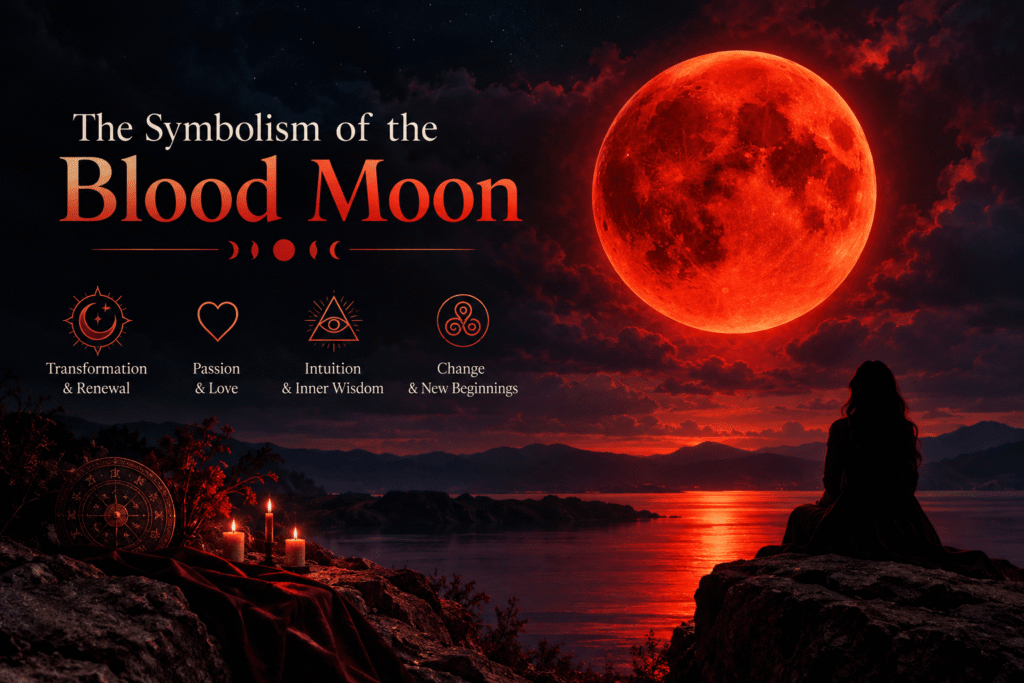
During a total lunar eclipse, the full moon briefly changes from appearing silver to glowing a rich, rusty red. It occurs slowly, as if the sky is holding its breath. People have been wondering what this particular moment meant for thousands of years, and it’s easy to understand why.
For centuries, cultures around the world have been fascinated by the symbolism of the blood moon, even before the science behind it was understood. Ancient societies saw it as a warning, an omen, or even a divine message written across the heavens. We now understand that the reddish glow is the result of sunlight filtering onto the moon’s surface after bending through Earth’s atmosphere, the same process that gives our sunsets their orange and pink hues. However, understanding the science hasn’t reduced the excitement of the phenomenon even a little bit.
Why Does the Moon Turn Red?
Earth passes directly between the Sun and the Moon during a total lunar eclipse, creating a shadow on the Moon’s surface. Earth’s atmosphere scatters light of shorter wavelengths (like blue) while allowing longer red wavelengths to pass through and bend around the planet’s edge, giving the Moon its well-known copper-red color instead of going entirely dark. We get the striking “blood moon” appearance when that light strikes the Moon.
Here are some things to be aware of regarding this phenomenon:
- It can occur only during a full Moon, when the Sun, Earth, and Moon are nearly perfectly aligned.
- The amount of dust, clouds, and pollution in the Earth’s atmosphere at any given time determines the precise shade of red.
- Volcanic eruptions in the years before an eclipse can intensify the red hue.
- A lunar eclipse is safe to see with the naked eye, unlike a solar eclipse.
A Look at Past Blood Moons
Long before telescopes and star charts, this celestial event held great significance in mythology, religion, and folklore. Examining historical blood moons shows how diverse ancient societies interpreted the same sky.
- Mesopotamian cultures believed the eclipse was an attack on the king, and rituals were performed to protect the throne.
- Ancient China saw it as a celestial dragon swallowing the moon, and communities would beat drums to scare it away.
- Inca civilization saw it as a jaguar attacking and biting the moon, a symbol of danger for their people.
- Medieval Europe often linked lunar eclipses to coming disasters, plagues or other problems.
- More recently, a “tetrad” of four consecutive total lunar eclipses in 2014–2015 sparked an extensive debate about biblical prophecy and brought the phenomenon to the attention of people around the world.
It’s quite interesting to see how many cultures have come up with similar themes of change, caution, and transformation, despite being separated by centuries and oceans. That pattern alone demonstrates the connection between people and the night sky.
What the Blood Moon Symbolizes Today
Nowadays, people do not see the blood moon as a warning or scary sign anymore; it’s more about reflection.
- Many people connect it with:
As the moon completes a cycle, there are endings and fresh starts. - A period of introspection or emotional release.
- A reminder of how we are so small and connected to the much larger universe.
- A rare chance to stop and genuinely look at the sky rather than ignoring it.
Even if you are not into the spiritual side of it, standing outside while the moon changes color in front of you is an extremely fascinating experience.
How Long Does the Blood Moon Last?
One of the most frequent questions people have after noticing the first glance of red is “when does the blood moon end”. Depending on the stage of the eclipse you are observing, the answer varies.
There are multiple stages to a total lunar eclipse: totality, when the moon is completely covered in that red glow, comes after the partial eclipse, which starts when Earth’s shadow begins to move across the moon.
Depending on the particular eclipse, totality itself can last anywhere from a few minutes to more than an hour. As the moon emerges from Earth’s shadow after totality, it gradually brightens once more, going through a partial phase before reverting to its typical silvery hue.
Although the red “blood moon” phase itself is typically the shorter middle stretch that everyone waits for, the entire lunar eclipse, from the first shadow to the last, can take several hours to complete.
The timing of the eclipse depends on your specific location. It is always best to check the exact date and time so you do not miss the eclipse. For upcoming eclipses and more information, NASA’s skywatching updates are a reliable source to stay up to date (https://www.nasa.gov/).
How to Get the Best View?
Watching the lunar eclipse does not require expensive gear, but a few things make a real difference:
- For a deeper, more vibrant red, go somewhere with less light pollution.
- Give your eyes 15 to 20 minutes to get used to the dark.
- Totality may last for some time, so carry a chair and a blanket.
- During totality, amazing detail on the lunar surface can be seen through binoculars or a telescope.
It’s memorable to see a blood moon with the naked eye, but it’s entirely different to see it magnified through a proper telescope in a truly dark sky.
Watch the Next Blood Moon With Us
If you’ve ever wanted to see this phenomenon properly, Night Sky Adventure provides guided stargazing tours from a dark-sky observation site in Sonoma County’s Dry Creek Valley, away from city light pollution. You won’t just catch a glimpse of the blood moon with top-notch telescopes and knowledgeable astronomer guides; you’ll comprehend what you’re seeing in real time under some of the clearest skies on Earth. Book with us to see the next blood moon as it should be.