
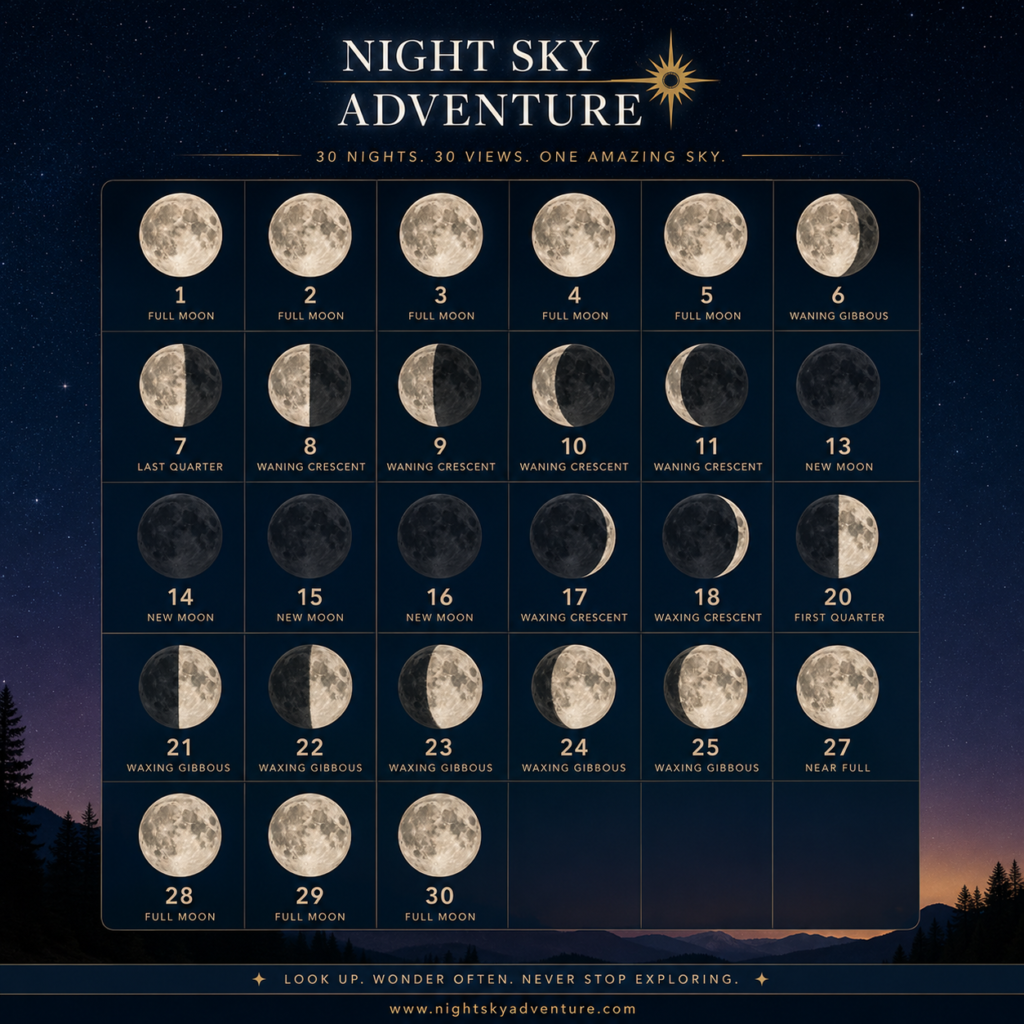
Time used to be measured by observing the movement of the sun, moon, and stars; but with smartphones and digital calendars being common nowadays, this fact has been forgotten by most people. For many years before the existence of calendars, people depended on the movement of the sun and moon to organize their day-to-day activities and festivals.
In today’s society, one comes across words like lunar months, solar calendar, or Gregorian calendar, but knows very little about how they came to be. Studying them gives us a great insight into how astronomy and cultures have been linked together through time.
“ A lunar month is the time taken by the Moon to complete one full cycle of its phases, from one New Moon to the next. It lasts approximately 29.5 days (29 days, 12 hours, and 44 minutes) and is scientifically known as a synodic month. “
What Is a Lunar Month and Why Does It Matter?
Amongst some of the most popular questions raised by people is “What is a lunar month?”
A lunar month refers to the duration of the complete revolution of the Moon through all the different phases to reach another new moon after one cycle. The period takes about 29.5 days on average.
How long is a lunar month? This does not take precisely 30 days. However, it varies to some extent since it depends on the movement of the moon around the Earth. For this reason, the lunar calendars usually switch the periods of the months from 29 to 30 days. Since the lunar phases were easily observable, ancient civilizations used them as the first clock in nature.
Understanding the Lunar and Solar Calendar Systems
In order to comprehend the development of calendars, we need to understand the difference between the lunar and solar calendars. The lunar calendar depends mainly on the Moon’s cycles. The year consists of lunar months that begin from the beginning of each lunar month.
As for the solar calendar, it measures the time by the Earth’s revolution around the Sun.
It means that it measures about 365.24 days needed to go around the Sun. As for the definition of the solar calendar, it is necessary to mention the Gregorian calendar, which is known and used worldwide now. Both calendars have some advantages, depending on their use.
Solar Calendar vs Lunar: Why the Difference Matters
The conflict between the solar and lunar calendars has nothing to do with preference; instead, it has everything to do with what each calendar is measuring. While the solar calendar has 365 days, the lunar calendar has less because of its twelve-month system. The difference is evident in the way dates correspond with seasons. The solar calendar remains constant in terms of seasons, while the lunar calendar changes over the course of a year.
Examples of this include:
- The solar calendar keeps summer, winter, spring, and autumn constant.
- The lunar calendar passes through the seasons.
- Religious events using the lunar calendar pass through different seasons from generation to generation.
How Many Months Are in a Lunar Year?
Another question that is often asked is how many months are in a lunar year?
The answer is that a normal lunar year has 12 months in it. Since one lunar month usually lasts for about 29.5 days, it takes approximately 354 days to complete a whole lunar year. Thus, we can say that a lunar year is 11 days less than a solar year.
Lunar Calendar vs Gregorian Calendar
When discussing the differences between the lunar calendar and the Gregorian calendar, we should point out two very different methods of measuring time.
While the Gregorian calendar, created in 1582, aimed at improving the Julian calendar, lunar calendars still rely on the phases of the Moon.
Some of the most distinctive features of both calendars are the following:
- Gregorian calendar – about 365 days in a year.
- Lunar calendar – about 354 days in a year.
Gregorian dates are always related to the seasons of the year.
Dates of the lunar calendar change throughout the year.
Lunisolar Calendar vs Gregorian Calendar: A Hybrid Approach
Lunisolar calendars were an option for certain cultures that decided to take the route between lunisolar and solar calendars. The difference between the lunisolar calendar and the Gregorian calendar presents a great compromise.
The lunisolar calendar operates on lunar months but incorporates additional months from time to time so that the lunar cycle stays synchronized with the solar cycle. In this way, a lunisolar calendar can incorporate both moon cycles and seasons. There are quite a few lunisolar calendars used in the modern world.
Looking Up to Understand Time
While the advanced technology in today’s world provides the answer instantaneously, the basis of the art of timekeeping can only be traced back to the movements of the sun, moon and the stars. As one ponders the concept of lunar and solar calendars, the difference between lunar and Gregorian calendars, or even considers what a lunar month is, one finds out how closely the development of human civilization is intertwined with the sun, moon and stars above.
Are you ready to delve deeper into the night sky? Look no further than Night Sky Adventure, where you can find everything there is to know about astronomy, celestial phenomena, and other interesting facts about the cosmos. All you have to do is to get in touch with us.